


Product Identification
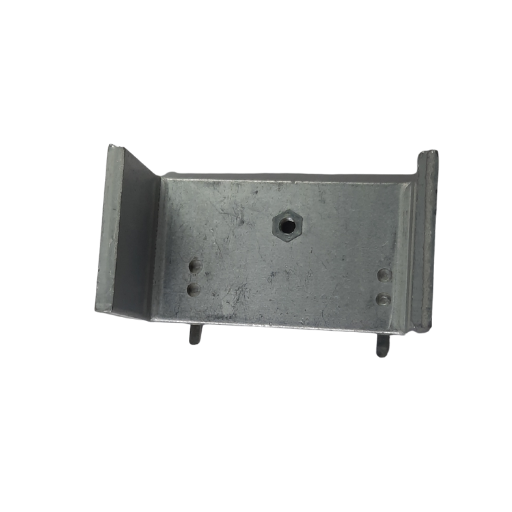
The image shows a "U shaped Heatsink," which is a thermal management component designed to dissipate heat from electronic devices and assemblies that generate significant thermal energy during operation. The U-shape increases the surface area for heat transfer and enables an efficient thermal path from the component to the ambient environment.
Product Use Case
Power Electronics: Cools voltage regulators, power transistors, thyristors, SSRs, IGBT modules, and relay drivers in industrial and commercial power supplies.
LED & Lighting: Used to enhance thermal management in high-power LED modules and lighting strips.
Computers & Servers: Heatsinks for embedded boards, small servers, drives, and expansion modules.
Instrumentation: Thermal protection in measurement instruments, amplifiers, and sensor interfaces.
HVAC/Industrial: Installed in control panels, drives, or junction boxes where space is limited but heat removal is critical.
Industries Served
| Industry | Typical Use Case |
|---|---|
| Industrial Automation | Drives, power controllers, PLC boards |
| Power & Energy | SMPS, DC-DC, and inverter assemblies |
| Lighting | LED drivers, industrial/high-power lighting strips |
| Consumer Electronics | Embedded boards, adapters, network equipment |
| Automobiles | ECUs, lighting control, power modules |
| Medical Electronics | Patient monitors, lab equipment thermal management |
| Renewable Energy | Solar microinverters, charge controllers |
| Telecom & Networking | Base stations, power backup systems |
Detailed Specifications
| Property | Specification |
|---|---|
| Material | Aluminum (typical), also available in copper or stainless steel |
| Size Range | Commonly from 17x15x7 mm to larger sizes (customizable—e.g., 2”–3”) |
| Thickness | 0.3 mm (for light-duty) to 10 mm (for industrial/heavy) |
| Shape | U-profile, may include mounting holes or slots for device attachment |
| Surface Finish | Natural, anodized, powder coated, or polished |
| Thermal Resistance | Typically 5–10 °C/W (varies with geometry/size) |
| Mounting Options | Central tapped hole and multiple mounting slots for screws/studs |
| Compatibility | Suitable for TO-220, TO-3, flat-pack semiconductor, LED boards, etc. |
| Hardness | Up to 40 HRC (aluminum/steel) |
Key Design Features
Enhanced Heat Dissipation: The U-shape offers a large exposed surface for natural or forced convection cooling, protecting heat-sensitive components by transferring and dissipating excess thermal energy.
Mechanical Strength: Profile provides good rigidity—essential for mounting power devices, ensuring reliable contact pressure and long-term flatness.
Flexible Mounting: Multiple screw holes, a central mounting point, and customized geometry provide easy integration into PCBs, power packs, and chassis.
Corrosion Resistance: Material options and surface treatments (anodizing, powder coating) ensure reliable operation in demanding or outdoor environments.
Critical Advantages
Thermal Efficiency: Lightweight, cost-effective, and very efficient at dissipating heat from compact/sealed assemblies.
Modular: Can be customized for different devices, board layouts, and enclosure types.
Durable: Excellent corrosion resistance and mechanical stability, suitable even for harsh or outdoor applications.
U-shaped heatsinks are vital in modern electronics and industry, providing reliable, space-saving thermal management for a wide breadth of power and signal systems.
Product Identification
The image shows a "Customised Heatsink," a precision-machined or fabricated thermal management part designed for cooling specific electronic components, assemblies, or custom equipment. Its unique geometry—featuring bends, slots, and custom mounting features—optimizes it for integration into nonstandard or specialized applications where standard heatsinks do not fit or deliver sufficient performance.
Product Use Case
IC and Semiconductor Cooling: Custom shapes are designed to fit high-power transistors, voltage regulators, or MOSFETs in dedicated assemblies.
LED Drivers & Lighting Systems: Used with boards where geometry constraints or high output require specially-shaped thermal paths.
Embedded & IoT Hardware: Cooling for uniquely dimensioned boards in sensors, gateways, custom controllers, or industrial PCs.
Test Equipment & Power Modules: Ensures reliable operation of unique lab or production test fixtures/loads with nonstandard layouts.
Industries Served
| Industry | Typical Use Case |
|---|---|
| Industrial Automation | Custom power modules, motion controllers |
| LED Lighting | Nonstandard form-factor driver/fixture thermal solutions |
| Medical/Lab Equipment | Custom analyzers, imaging, and sensitive electronics |
| Telecom & Networking | Equipment bays, racks, and custom telecom hardware |
| Transportation | Rail/automotive control devices, surveillance |
| Precision Instruments | Lab devices, calibration, and test setups |
| Computers & Servers | Embedded, edge, or custom core devices |
| Renewable Energy | Custom solar and inverter solutions |
Detailed Specifications
| Property | Specification |
|---|---|
| Material | Aluminum alloy (e.g., 6063 T5), can be copper/stainless for special needs |
| Dimensions | Customized per application/project; width, height, depth variable |
| Surface Finish | Powder-coated, anodized, or polished for corrosion resistance & aesthetics |
| Wall Thickness | Usually 1–10 mm, depending on part size/thermal load |
| Mounting Features | Custom slots, holes, tabs for device or PCB integration |
| Thermal Performance | Designed to meet specific power dissipation goals (e.g., <1°C/W to >10°C/W) |
| Manufacturing Process | CNC machining, extrusion, stamping, folding; possibly skived or bonded |
| Compliance | Can meet RoHS, UL, and application standards as required |
Key Design Features
Tailored Geometry: Custom-cut and formed for perfect fit in proprietary assemblies, unusual layouts, or compact custom enclosures where off-the-shelf heatsinks cannot be used.
Enhanced Cooling: Strategic fin/slot/cutout designs improve heat convection, especially when combined with forced airflow or upright mounting.
Integrated Mounting: Special tabs, slots, or threading allow for direct PCB, chassis, or enclosure attachment—reducing hardware and assembly steps.
Surface Treatments: Anodizing or powder coating not only resists corrosion but also improves emissivity for thermal performance.
Critical Advantages
Form-fit-function: Enables thermal management in compact, irregular, or high-density installations.
Performance Optimization: Meets exact thermal design profile for sensitive, mission-critical, or high-power electronics.
Reduced Assembly Complexity: Integration of mounting features reduces fastener count, assembly time, and cost.
Scalability: The Same design can be adapted for batch production or made unique for prototypes and R&D builds.
Customised heatsinks provide engineered cooling where traditional products do not suffice—serving key roles in modern electronics, demanding industrial controls, and innovative product designs.
Product Identification
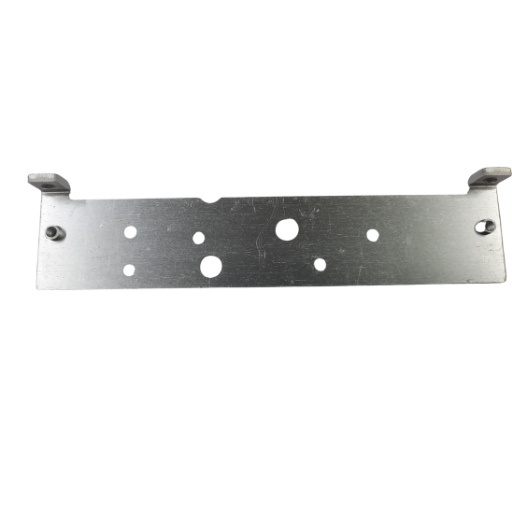
The image shows a "2.5mm Aluminium Mounting Plate/Bracket," a precision-engineered, flat structural or enclosure component commonly used as a mounting base or interface within mechanical, electrical, and industrial assemblies. The given design includes a series of pre-drilled holes to facilitate mounting and integration into larger systems or cabinets.
Product Use Case
Mounting Plate: Acts as a foundational mounting surface for electronic circuit boards, relays, power supplies, terminal blocks, or other devices inside enclosures.
Structural Component: Serves as a stiffener, spreader, or linking bracket in fabricated frames and assemblies for automation, robotics, or machinery.
Enclosure Interface: Used to adapt standard panels to specialized devices, connectors, or sub-assemblies, facilitating installation and equipment transitions.
Customizable Platform: Can be drilled or modified on-site to accommodate changes, making it well-suited for R&D and prototyping environments.
Industries Served
| Industry | Typical Use Case |
|---|---|
| Electrical & Electronics | Mounting PCB, relays, wiring harnesses in panels |
| Automation & Robotics | Structural brackets in machines, sensor holder |
| Power & Utilities | Substation, inverter, or battery pack mounting |
| Automotive & Transport | Custom mounts for electronic modules, junctions |
| Telecom & Data | Hardware trays, patch panel interfaces |
| Aerospace & Marine | Lightweight marine/aircraft component mounts |
| Signage & Displays | Structural support in architectural elements |
| Construction | Brackets for modular furniture, shelving, safety equipment |
Detailed Specifications
| Property | Specification |
|---|---|
| Material | Aluminium alloy (commonly 5052, 6061, or 1100) |
| Thickness | 2.5 mm |
| Dimensions | Customizable; typical panel 120–600 mm in length/width |
| Surface Finish | Smooth mill finish, anodized, or powder-coated |
| Design Features | Multiple mounting holes and edge bends for structural rigidity |
| Mechanical Strength | Lightweight yet strong, resists corrosion and oxidation |
| Compliance | RoHS, REACH, and general industrial electrical standards |
Key Design Features
Precision Machining: High-tolerance (±0.1 mm) bracket or plate, often CNC-cut or laser-cut and drilled for fixture repeatability.
Multi-Hole Design: Pre-drilled holes and notches for versatile mounting options, cable routing, or integration with electronics and subassemblies.
Lightweight & Strong: Aluminum alloys provide a superior balance of low weight and adequate mechanical stiffness for most mounting needs.
Corrosion Resistance: Mill finish, anodizing, or other coatings protect the plate in both indoor and outdoor or humid environments.
Critical Advantages
Versatility: Suits a wide range of mechanical, electrical, and architectural assembly tasks.
Lightweight Durability: Aluminum provides excellent strength-to-weight and corrosion resistance without additional reinforcement.
Cost-Effective & Customizable: Easy to cut, drill, and machine—ideal for custom, OEM, and low-to-mid volume batch work.
A 2.5mm aluminum mounting plate/bracket is a foundational component in modern manufacturing—offering modular, easily customizable, and highly reliable support across automation, electrical, energy, and construction sectors.
Product Identification
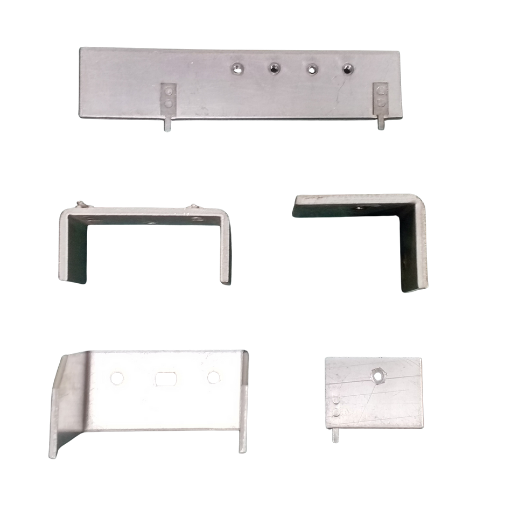
The image presents a collection of "Aluminium Flat, C, and L Shaped Heatsinks." These are simple, extruded or machined aluminum heatsink profiles designed in various flat, C, and L geometries for passive cooling of power electronics and other heat-sensitive components. Each shape serves unique mounting and thermal requirements in compact and modular assemblies.
Product Use Case
PCBs & Modules: Widely used for passive cooling of regulators, MOSFETs, diodes, bridge rectifiers, and amplifiers on circuit boards and as edge or backplate heatsinks.
Enclosure Cooling: Larger L/C shapes are fixed to enclosure sides, acting both as brackets and thermal pathways for heat-intensive components.
Relay & SSR Mounting: Many solid-state relays, DIN modules, or discrete power devices come with flat/C/L mount footprints for clip-on or screw-on cooling.
LED & Power Electronics: Flat profiles are ideal for linear LED drivers, panel lighting, and compact power module applications where vertical airflow or tight fit is needed.
Custom Assemblies: Adapted in motion control, test equipment, telecom, automation panels, and industrial machines as general-purpose heatsinks.
Industries Served
| Industry | Typical Use Case |
|---|---|
| Power Electronics | Passive cooling of discrete/linear power devices |
| Automation/Control | Relay, SSR, and PCB edge cooling in cabinets |
| Lighting | LED drivers, linear lighting modules |
| Renewable Energy | Solar panel combiner boxes, microinverter stress relief |
| Instrumentation | Sensor, amplifier, and test/measurement device protection |
| Automotive | ECU, power, and charger cooling |
| Telecom/Data | Small-scale radio or network equipment |
Detailed Specifications
| Shape | Material | Thickness Range | Common Finishes | Typical Applications |
|---|---|---|---|---|
| Flat | Aluminum 6063/6061 | 1–10 mm | Mill, anodized, powder | PCB, flat module cooling |
| L-Shaped | Aluminum 6063/6061 | 2–10 mm | Mill, anodized, powder | Board edge, power packs |
| C-Shaped | Aluminum 6063/6061 | 2–10 mm | Mill, anodized, powder | Enclosure side, SSR, relays |
Mounting Features: Multiple pre-drilled or tapped holes, cutouts, or slots for device and cabinet integration.
Thermal Resistance: Typically 5–15 °C/W, varies with geometry and length.
Manufacturing: Extrusion, CNC machining, punching, and custom fabrication are used for these profiles.
Key Design Features
Shape Versatility: Flat types dissipate heat from surface-mount or flat-package components; L and C shapes wrap around board edges or modules, maximizing heat dissipation without increasing area.
Efficient Surface Area: Each profile increases surface area for convection cooling, either by lying flat, wrapping, or standing upright in airflow paths.
Simple Integration: Holes and slots match standard electronic mounting layouts and panel formats, allowing flexible assembly in dense or distributed systems.
Lightweight and Corrosion Resistant: Aluminum ensures a good balance of weight, conductivity, and low maintenance in a range of environments.
Critical Advantages
Shape & Mounting Flexibility: Flat, C, and L profiles allow engineers to select optimum cooling profiles—balancing size, airflow, and fit for each application.
Customizable: Easily drilled, cut, or machined to suit a wide variety of product footprints or OEM configurations.
Low Cost, High Impact: Effective, scalable thermal management with minimal weight or mechanical complexity.
Aluminium flat, C, and L shaped heatsinks are essential, adaptable, and highly reliable building blocks for cooling electronics, especially where modularity, footprint, and cost matter most.
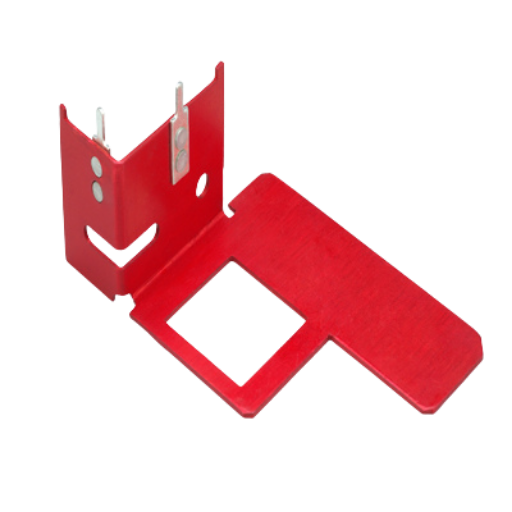
The image shows an "Aluminium Heatsink," distinguished by its custom shape, bright red anodized or powder-coated finish, and mounting cutouts. This type is engineered for modern electronic modules—especially for compact, visually distinct, or tightly integrated circuit boards—where efficient thermal management and corrosion resistance are critical.
Product Use Case
LED Lighting Modules: Compact cooling of LED drivers, COB LEDs, and light engines—especially for colored fixture series or high-visibility installs.
Power Supplies/Converters: Mounted on switching transistors, regulators, and MOSFETs in SMPS or DC-DC modules.
IoT & Embedded Boards: Used in wireless gateways, network nodes, or processor boards where space and reliability matter.
Test & Measurement: Provides efficient, durable cooling for precision measurement or sensor boards in lab and industrial environments.
Consumer & Specialty Devices: Featured in unique consumer/industrial products as visible, colorful, or functionally differentiated heatsinks.
Industries Served
| Industry | Typical Application |
|---|---|
| LED Lighting | COB drivers, linear modules, outdoor/architectural |
| Automation/Control | Relay drivers, SSRs, power controllers, industrial IoT |
| Consumer Electronics | Gaming, wearables, smart home + colored device lines |
| Power Electronics | DC-DC converters, SMPS, chargers on colored PCBs |
| Automotive | ECU accessories, LED matrix, charger hardware |
| Telecom/Datacom | Base stations, radio cooling, network cards |
| Lab/Medical | Measurement, healthcare embedded solutions |
Detailed Specifications
| Property | Specification |
|---|---|
| Material | Aluminum alloy (6000 series, usually 6063 or 6061) |
| Thickness | 1–10 mm, customized based on application/design |
| Surface Finish | Red anodized (mainly) or powder coated for corrosion resistance |
| Design Features | Precision CNC cut slots and device mounting holes, snap-in tabs |
| Thermal Resistance | Typically 5–20 °C/W (application-specific) |
| Mounting | Clip-on, screw, thermal adhesive or snap-fit on PCB/enclosure |
| RoHS/Compliance | Available as per industry standards |
Key Design Features
Red Anodized/Powder Finish: Superior corrosion resistance, distinct visual ID, and high surface emissivity to enhance heat radiation.
Custom Profile & Cutouts: Optimized for modern electronics—slots and shapes ensure direct contact with hot components and easy assembly.
Compact & Robust: Efficient in small-volume, dense PCBs and devices; resists scratching, oxidation, and wear.
OEM Branding: Color options enable coding or branding in industrial or consumer products.
Critical Advantages
Enhanced Corrosion & Scratch Resistance: Anodized/powder surfaces protect even in outdoor, high-use, or chemically harsh environments.
Improved Heat Dissipation: High-emissivity coating and custom geometry drive thermal efficiency in restricted spaces.
Visual Identification & Branding: Available in colors for rapid ID, assembly line matching, or product branding.
Highly Customizable: Can be fabricated in a wide range of profiles, mounting options, and color finishes to meet exact design needs.
Red anodized aluminium heatsinks are at the intersection of advanced thermal management, rugged durability, and modern product design—making them prevalent in high-performance, compact, and visually distinctive electronics.
Product Identification
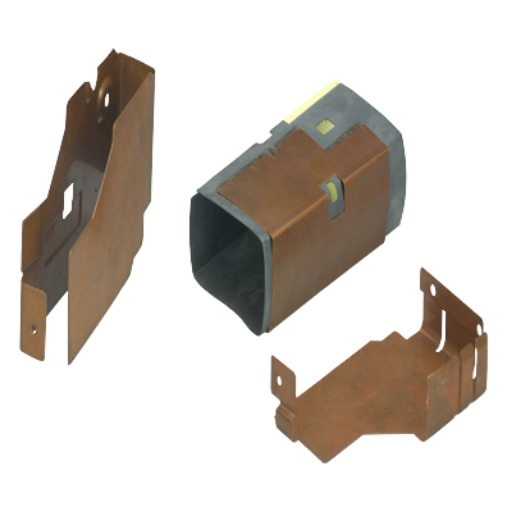
The image displays "Copper Heatsinks," which are high-efficiency thermal management components fabricated from copper sheet or plate, designed to maximize heat transfer from power electronic devices and critical components. These heatsinks are formed or stamped into complex geometries to interface tightly with semiconductors, power modules, or RF components where rapid and effective dissipation of heat is essential.
Product Use Case
High-Power Semiconductors: Cooling for IGBTs, MOSFETs, rectifiers, and high-output voltage regulators in compact modules.
Computer & Server Hardware: Essential for CPUs, GPU modules, memory VRMs, and SSDs (including M.2 drives).
Automotive & EV Systems: Power inverters, battery interfacing, DC-DC converters, and LED/high-current lighting in electric/hybrid vehicles.
Telecom/Base Stations: Power amplifiers, RF modules, network routers, and high-throughput communications hardware.
Industrial/Robotics: Motor drivers, power supplies, CNC control systems, and large relay switching.
Lab/Medical & Instrumentation: Sensing, imaging, and analytical devices that combine high sensitivity with thermal stability needs.
Industries Served
| Industry | Typical Application |
|---|---|
| Power Electronics | High-current modules, relays, IGBT/MOSFET packs |
| Computers/Data Centers | CPUs, GPUs, SSDs, high-density servers |
| Automotive/EV/Hybrid | Battery, inverter & motor controller cooling |
| Telecom/Networking | RF power, router, and switch cooling |
| Industrial Automation | Robust HVAC, control, and robotics |
| Medical & Scientific | Imaging, sensing, and analytical tools |
| Renewable Energy | Power conversion in solar/wind modules |
Detailed Specifications
| Property | Specification |
|---|---|
| Material | Pure Copper (typically C11000 or C10100, 99.9%+) |
| Shape/Type | Stamped, bent, folded, or skived; can include complex features |
| Thickness | 0.5–5 mm sheet (custom up to 10 mm) |
| Surface Finish | Bare, tinned, or anti-oxidation coating |
| Thermal Conductivity | ~390–400 W/m·K (Cu1100 class) |
| Mounting Features | Tabs, slots, and holes for direct device and PCB/chassis mounting |
| Compliance | RoHS available, meets global electronics standards |
Key Design Features
Superior Thermal Conductivity: Pure copper has nearly twice the conductivity of aluminum, making it ideal for removing heat quickly from small or high-power-density packages.
Custom & Complex Shapes: Stamped or folded into deep, thin profiles to fit tight spaces and high-power chips; enables precise fit for modern electronics.
Surface Area Maximized: Finned, serrated, or louvered designs substantially enhance airflow contact, boosting natural and forced convection.
Corrosion Resistant: Optionally plated or coated for environments where copper might oxidize or discolor.
Critical Advantages
Highest Cooling Efficiency: Ideal for heavy-duty requirements where space is tight and heat output is high.
Durability & Longevity: Withstands repeated thermal cycling and daily high load—minimizing device degradation.
Bespoke & Versatile: Can be manufactured to exact dimensions and mounting patterns required for next-generation electronics.
Industry-Standard: Preferred for mission-critical and premium applications despite the higher cost due to unmatched performance.
Copper heatsinks remain the premium choice for all electronics and industries where thermal reliability, consistent performance, and longevity are paramount—supporting the move towards miniaturized, high-power, and rugged systems.